An infrastructure investment rarely becomes urgent overnight.
The warning signs were usually there first: an approaching end-of-support date, aging hardware, increasing capacity demands, a new location on the horizon, or a business initiative that would require technology the current environment wasn't designed to support.
Without a roadmap, those predictable needs can still become surprises.
An organization realizes equipment needs to be replaced only after support has expired. A new office is three months from opening when the team discovers the equipment it needs has a months-long lead time. Or a hardware refresh budgeted using last year's pricing suddenly costs significantly more than expected.
These are situations we encounter when helping organizations evaluate their infrastructure and plan for future investments. And they're often avoidable.
That's the difference between buying technology and planning infrastructure.
A strong infrastructure roadmap connects where the business is today with where it expects to go over the next three to five years. It gives IT leaders visibility into upcoming investments, finance teams a clearer picture of future spending, and leadership insight into how technology supports broader organizational priorities.
More importantly, it creates room to make decisions before circumstances make them for you.
Start with the Business, Not the Technology
When we begin infrastructure roadmapping conversations, one of our first questions isn't about servers, switches, or storage.
It's much simpler: Where is the organization trying to go?
An organization planning significant growth has different infrastructure needs than one consolidating locations. A company preparing to move workloads to the cloud shouldn't make the same investments as one planning to maintain an on-premises environment. If leadership wants to expand AI capabilities, open new facilities, or introduce new services, the infrastructure roadmap needs to account for the requirements of those goals.
Technology planning can't happen separately from business planning.
We want to understand an organization's three- to five-year direction before recommending significant infrastructure investments. Investing heavily in local infrastructure makes little sense if the larger business strategy calls for moving those workloads to the cloud.
That connection can be difficult because technology is often viewed primarily as a cost center. Infrastructure doesn't always have a simple revenue number attached to it, making large investments harder to justify in the boardroom.
We've found that IT leaders don't always have the opportunity or resources to translate technical needs into business priorities, particularly in organizations without a dedicated CIO or CTO.
That's where we can help bridge the gap between IT and senior leadership, connecting technical decisions to business outcomes.
The roadmap becomes that bridge.
If You Don't Know What's Coming Next, You Don't Have a Roadmap
One of the clearest signs that an organization lacks a mature infrastructure roadmap is surprisingly simple: no one knows what's coming next.
We see it when we ask a client about the plan for a particular piece of infrastructure and realize there isn't one. End-of-life and end-of-support dates haven't been tracked. Equipment lead times haven't been considered. An upcoming expansion is known to the business, but its technology requirements haven't been incorporated into IT planning.
Those gaps matter because infrastructure has a lifecycle, whether an organization plans for it or not.
Hardware ages. Vendor support ends. Software requirements change. Security updates stop. Capacity needs grow.
CISA recommends tracking vendor end-of-life timelines and planning upgrades before hardware, operating systems, or software are no longer supported. NIST similarly advises organizations to replace system components when vendor or manufacturer support is no longer available, noting that unsupported systems may no longer receive critical patches or product updates.
A roadmap makes those dates visible early enough to decide what to do about them.
That might mean replacing equipment. It might mean moving a workload elsewhere. It might mean extending the lifecycle of one investment so another can happen sooner.
The important part is that the decision is deliberate.
Plan Three to Five Years Ahead—Then Expect the Plan to Change
For most organizations, we recommend looking roughly three to five years ahead.
That window aligns reasonably well with the lifecycle of many infrastructure investments and gives organizations enough visibility to anticipate major capital needs.
But a three- to five-year roadmap should never be mistaken for a three- to five-year promise.
Technology changes too quickly for that. So do businesses.
Budgets freeze. Organizations grow or contract. Leadership priorities shift. New security risks emerge. A project planned for year three may need to move into year two or year four.
The roadmap needs to move with them.
We encourage organizations to revisit their roadmaps at least annually, rather than treating them as completed documents filed away.
That annual review is what turns the roadmap from a spreadsheet into a planning tool.
It also allows organizations to smooth infrastructure spending over time. Some businesses are comfortable making a large capital investment every five or seven years. Others would rather distribute refreshes so technology spending stays more consistent year over year.
Neither model is inherently right or wrong.
The right model is the one that aligns technology lifecycles with how the organization plans, budgets, and operates.
Today's Budget Needs More Breathing Room
That flexibility is particularly important in the current infrastructure market.
One of the biggest disconnects we're seeing between infrastructure roadmaps and actual budgets in 2026 is hardware pricing.
Organizations that haven't priced equipment recently can be surprised by how dramatically the economics have changed. It's a conversation we frequently have with clients who planned their next infrastructure refresh using costs from several years ago.
The broader market supports that concern.
AI and data center demand have contributed to significant pressure on memory and storage supply. Gartner reported in May that AI-induced memory shortages were causing substantial hardware price increases and creating significant challenges for 2026 IT budgets. TrendForce reported in September that server DRAM remains undersupplied, with conventional DRAM prices expected to rise another 10–15% quarter over quarter in Q4 and enterprise SSD pricing facing additional upward pressure.
For organizations building multi-year budgets, the lesson isn't to predict the exact price of a server three years from now.
A quote received today shouldn't automatically become the budget for a purchase 12 or 18 months from now.
We encourage organizations to build flexibility into their infrastructure budgets to account for market changes, evolving requirements, and unforeseen priorities. That buffer becomes especially important when external factors can change an investment's cost long before it's time to purchase.
In other words: build the roadmap around what you know, but leave room for what you don't.
Translate Technology Risk Into Business Risk
A roadmap is only useful if the organization can act on it. For IT leaders, that often means getting executives and finance teams to understand why an investment matters before something breaks.
Technical explanations usually aren't enough.
One of the most important things we emphasize when working with clients is the need to communicate technology risk in terms that business leadership understands.
Downtime provides a straightforward example. Rather than telling leadership that aging infrastructure presents a technical availability risk, ask a more useful question: If the business were down for 24 hours, what would that cost?
Lost productivity. Lost transactions. Delayed operations. Customer impact. Recovery costs.
The same thinking applies to cybersecurity. Aging infrastructure can eventually lose vendor support and security updates, creating risk that may be difficult for nontechnical leadership to see until an incident occurs.
The goal isn't to make leadership understand every technical detail. It's to translate the consequence. We often compare routine infrastructure maintenance to changing the oil in a car. You make a smaller investment today so you don't end up having to replace the engine tomorrow.
Routine infrastructure investments may feel like an expense today, but delaying them can create a much larger expense later.
Delaying an Investment Is Still a Financial Decision
The current hardware market has made that particularly clear.
We've worked with organizations that stayed on schedule with lifecycle refreshes over the last several years and completed planned purchases before recent price increases.
In some cases, those decisions helped clients avoid what could now be six- or seven-figure additional costs.
We've also seen the opposite. Organizations that delayed recommended refreshes are now evaluating replacements at substantially higher prices than they would have faced previously.
No one could have perfectly predicted the market. That's not the point.
Roadmapping isn't about predicting everything correctly. It's about giving an organization enough visibility to make an informed decision while it still has options.
Waiting is a decision too.
Sometimes delaying a project is absolutely the right call. Capital may need to go to a more important place. Business priorities may change. A different technology strategy may make the planned investment unnecessary.
But there is a significant difference between deliberately moving an investment and simply not realizing it was coming.
If You Don't Have a Roadmap, Start with What You're Spending Today
For organizations without a mature infrastructure roadmap—or even a formal IT budget—the process can feel overwhelming.
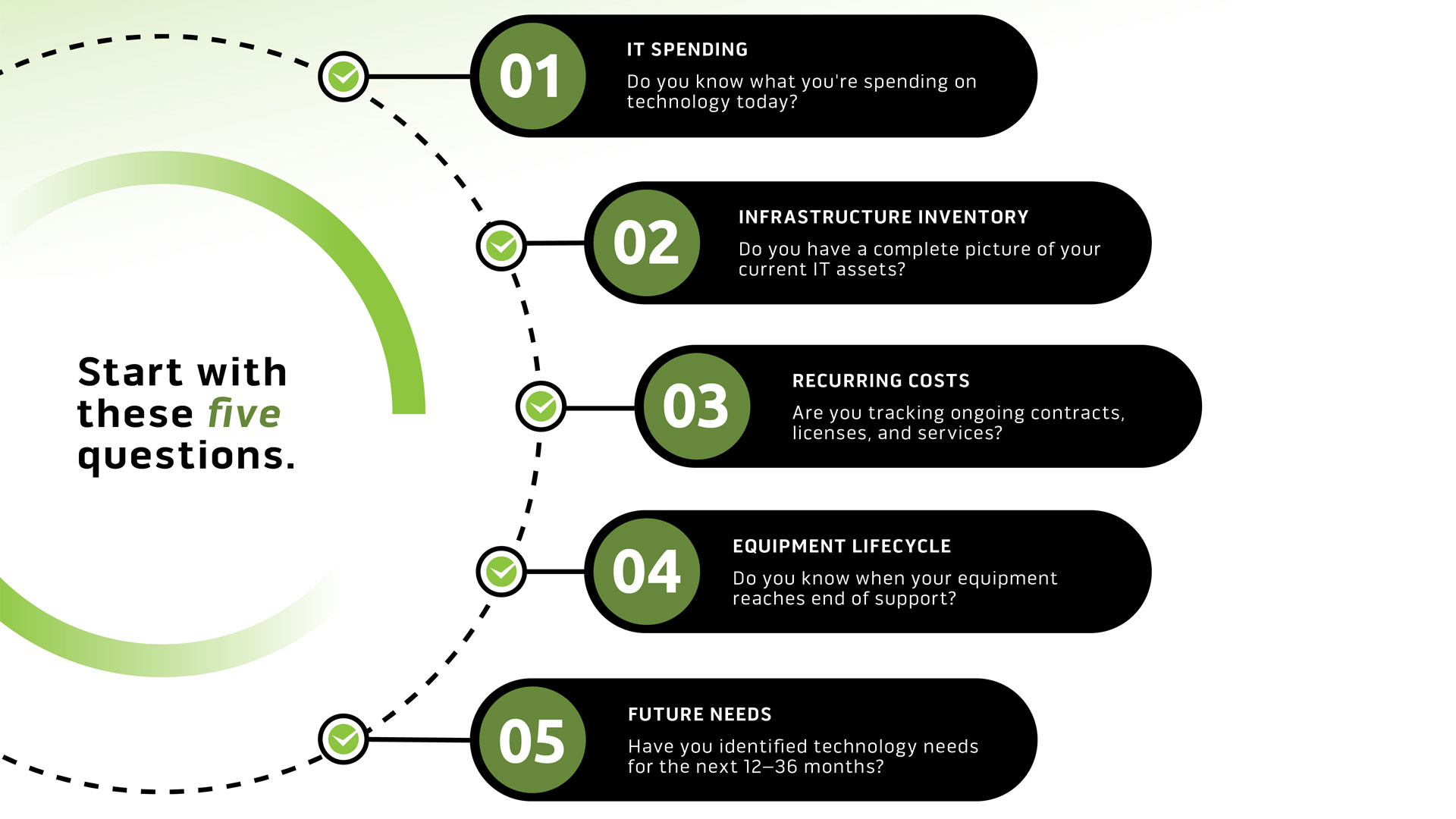
It doesn't need to start with a perfect five-year forecast. Start with visibility.
- What are you spending on technology today?
- Where is that money going?
- What infrastructure do you own?
- What contracts, licenses, and services are recurring?
- What equipment is approaching the end of its supported lifecycle?
- What business initiatives are likely to create new technology needs over the next 12, 24, or 36 months?
We've worked with organizations that begin with something as simple as an accounting report of IT spending.
From there, we can help categorize those expenses, analyze where the money is going, and connect spending to the technology environment. That gives us a baseline for understanding what the organization has today and what it may need tomorrow.
Then the roadmap can begin taking shape. It doesn't have to be perfect, but it does have to exist.
Because the strongest infrastructure roadmap isn't the one that predicts every technology change or gets every future cost exactly right, it's the one that gives the organization enough visibility to adapt when those things inevitably change.
And when infrastructure planning, business strategy, and budgeting are connected, IT stops being a series of unexpected expenses. It becomes an investment that the organization can actually plan for.